About
About This Project
OCHRID.COM presents the first ever faithful, uncensored, and free to use and share English translation of the Prologue from Ochrid by St. Nikolai Velimirović. This translation is made directly from the original Serbian text, preserving every word St. Nikolai wrote, with only minor tweaks for clarity, never meaning.
The most widely available English edition is under copyright and can therefore not be reproduced or distributed without permission. It also contains cases of censorship. Other lesser known translations exist but are not available online, and cost several hundred dollars to purchase. This translation exists to preserve the original text written by St. Nikolai and make it available to the faithful without cost barriers and for all uses. We believe the faithful deserve access to this treasure of a text with no restrictions.
This work is licensed under Creative Commons Attribution-ShareAlike 4.0 (CC BY-SA 4.0), which means anyone can use, copy, and share it freely as long as they credit Rdr. Marcian Sakarya and OCHRID.COM. This work is offered freely to the Church, that the wisdom of St. Nikolai might be accessible to all who seek it.
The Prologue from Ochrid is a collection of lives of saints and homilies for every day of the year, compiled by St. Nikolai Velimirović (1880-1956), Bishop of Ochrid and Žiča. This treasury of Orthodox wisdom has been a beloved companion to the faithful for generations, offering daily spiritual nourishment through the examples of the saints, beautiful hymns, profound reflections, and instructive homilies.
What This Site Provides
Daily Prologue Readings — The complete entry for each day of the year, including lives of saints, hymns of praise, reflections, contemplations, and homilies translated directly from the original Serbian text
Daily Scripture Readings — The appointed Epistle and Gospel passages for each day, with fasting information and commemorations, computed by the Ochrid Orthodox Calendar Engine (OOCE)
The Library — A growing collection of books for prayer and reading. It currently contains the Psalter (all 151 Psalms in LXX numbering, arranged by kathisma and stasis for liturgical reading) and Prayers by the Lake by St. Nikolai Velimirovich (all 100 prayers, in Serbian and English), with more volumes to come
The Prayer Book — A full Orthodox prayer book including morning prayers, evening prayers, prayers before and after communion, and other essential prayers of the Church
Calendar Toggle — Switch between Old Calendar (Julian) and New Calendar (Gregorian) dates throughout the app
Translation Progress
This translation is an ongoing work. The calendar below shows our progress through the year.
Prayers by the Lake — Translation Progress
A new English translation of St. Nikolai's Молитве на језеру (1922), made directly from the Serbian original. Each cell below is one of the hundred prayers.
Source Material & License
The Prologue translation and the Psalter revision are original works by Rdr. Marcian Sakarya, licensed under Creative Commons Attribution-ShareAlike 4.0 (CC BY-SA 4.0). You are free to use, copy, and share these works as long as you provide attribution.
All other scripture text — the King James Version (New Testament and protocanonical Old Testament) and Brenton's Septuagint (deuterocanonical books) — is in the public domain.
Scripture readings and calendar information are computed locally by the Ochrid Orthodox Calendar Engine (OOCE), with algorithmic foundations derived from the Orthocal project by Brian Glass.
Scripture Sources
The Orthodox Church reads the Old Testament according to the Septuagint (often abbreviated LXX), the ancient Greek translation of the Hebrew scriptures completed in the centuries before Christ. The Septuagint is the Old Testament quoted by the Apostles in the New Testament, used by the Church Fathers, and read in Orthodox worship to this day. It differs from the Hebrew Masoretic text used by most Protestant Bibles in book order, chapter and verse numbering, and sometimes in meaning.
English-speaking Orthodox Christians have the Orthodox Study Bible, which corrects the New King James Version against the Septuagint, but it remains under copyright and uses modern English rather than the traditional liturgical register heard in most Orthodox parishes. OCHRID.COM is building a free, open-source English Old Testament translated directly from the Septuagint in the liturgical register of the King James Version. Our approach draws from two public-domain English translations of the LXX and harmonizes them into a consistent voice.
New Testament
The King James Version (1611). The KJV New Testament was translated from the same Greek manuscript tradition used by the Orthodox Church, and its language — “Thou,” “Thee,” “hath,” “doth” — is the register most English-speaking Orthodox Christians hear in worship.
Old Testament — Protocanonical Books
The protocanonical books are the Old Testament books accepted by all Christians — Genesis through Malachi. We currently use the King James Version for these books. Because the KJV was translated from the Hebrew Masoretic text rather than the Greek Septuagint, there are places where it diverges from the Orthodox reading. Aligning these books to the Septuagint is part of our long-term plan.
Old Testament — Deuterocanonical Books
The deuterocanonical books — Tobit, Judith, Wisdom of Solomon, Sirach (Ecclesiasticus), Baruch, the Letter of Jeremiah, 1–4 Maccabees, 1 Esdras, the Prayer of Manasseh, Susanna, and Bel and the Dragon — are books included in the Septuagint and read by the Orthodox Church but absent from most Protestant Bibles. For these we use Brenton's Septuagint, an 1851 English translation of the Greek Septuagint by Sir Lancelot Charles Lee Brenton. Brenton's is one of the few complete English translations of the LXX and is now in the public domain.
The Psalter
The Psalter receives special treatment because of its central place in Orthodox worship. Our base text is the LXX2012, a 2012 modernization of Brenton's Septuagint Psalms that corrects errors and updates archaic phrasing while remaining faithful to the Greek. We then revised every psalm into liturgical style — the “Thou/Thee/hath/doth” register of the King James Version — so the Psalter reads the way Orthodox Christians expect to hear Scripture in English. The result is all 151 Psalms (including the supernumerary Psalm 151) in Septuagint numbering, arranged by kathisma and stasis for use in the daily cycle of prayer.
What is “liturgical style”? When we say a text has been formatted for liturgical style, we mean it uses the same second-person pronouns (“Thou,” “Thee,” “Thy,” “Thine”) and verb forms (“hath,” “doth,” “cometh”) found in the King James Bible — the register that has defined English-language Orthodox worship for generations. Modern-English Septuagint translations exist, but they sound foreign in a liturgical setting. Our goal is a Septuagint text that could be read aloud at the analogion without jarring the ear.
Old Testament Progress
Our long-term goal is a complete English Old Testament that follows the Septuagint text and reads in the traditional liturgical register. The table below tracks where each group of books stands in that process.
| Book Group | Septuagint Text | Liturgical Style |
|---|---|---|
| Psalms (151) | ✓ | ✓ |
| Deuterocanon (Tobit, Wisdom, Sirach, etc.) | ✓ | — |
| Protocanonical OT (Genesis–Malachi) | — | — |
Septuagint Text = translated from or verified against the Greek LXX, with LXX book order and numbering. Liturgical Style = revised into the Thou/Thee/hath/doth register for use in worship.
Who's Behind This?
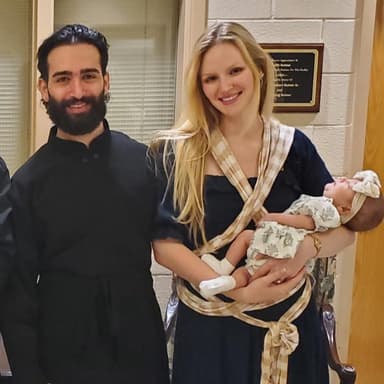
I'm Rdr. Marcian Sakarya, a Reader in the Russian Orthodox Church Outside of Russia. I live in North Carolina with my wife and daughter.
When I discovered that the standard English translation of the Prologue from Ochrid contained censorship and was locked behind copyright, I felt that St. Nikolai, whose work has profoundly influenced me, deserved better. St. Nikolai's complete words, unaltered and unfiltered, deserve to be freely accessible to every english speaking Orthodox Christian.
Over 600 hours have gone into this translation and development work so far, with hundreds more ahead. This is a labor of love, but your support helps cover hosting, development, and the time needed to complete the remaining translations with the care they deserve.
Lord Jesus Christ, Son of God, by the prayers of St. Nikolai Velimirović and all the saints, have mercy on us.