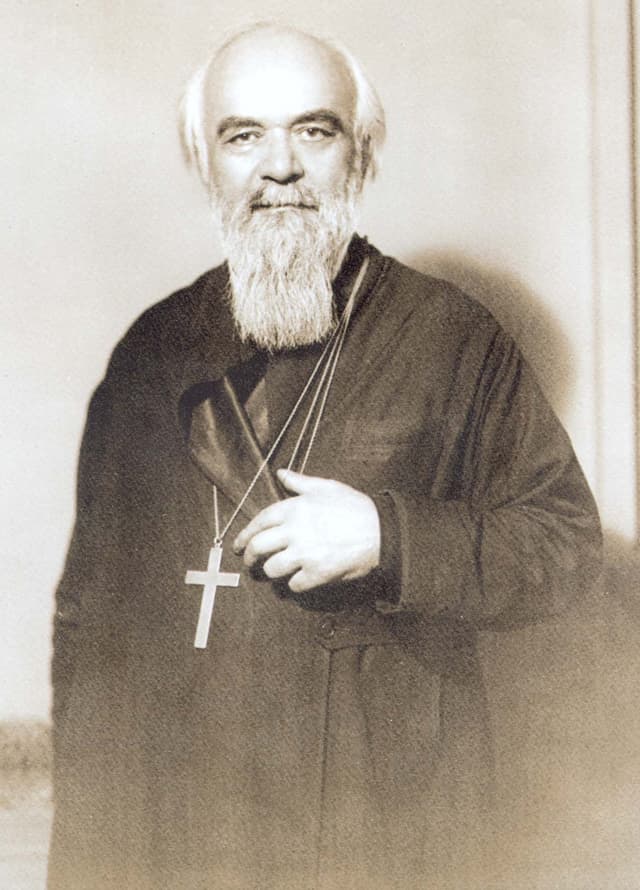
As bishop, 1920s
Serbia's New Chrysostom
St. Nikolai
Velimirovic
Bishop of Ochrid and Zica · 1880\u20131956
One of the most influential Orthodox theologians of the twentieth century, and the author of the Prologue from Ochrid — the text presented on this website. His complete works span twenty-three volumes.
“A great saint and Chrysostom of our day, whose significance for Orthodoxy can be compared only with that of Metropolitan Anthony. They were both universal teachers of the Orthodox Church.”
— St. John of Shanghai and San Francisco
Early Life & Education
Nikolai was born on January 5, 1880, in the village of Lelic in western Serbia. He attended the Seminary of St. Sava in Belgrade, graduating in 1905. Driven by a deep love of learning, he earned a doctorate in theology from Berne, Switzerland (1908), and a doctorate in philosophy from the University of Geneva (1909), defending a dissertation on the philosophy of George Berkeley.
By the end of 1909, he entered monastic life and was ordained to the priesthood on the same day. He was elevated to archimandrite in 1910, and began teaching at St. Sava Seminary in Belgrade the following year.
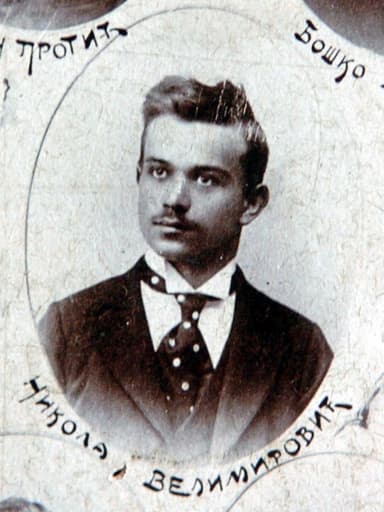
Student, 1909
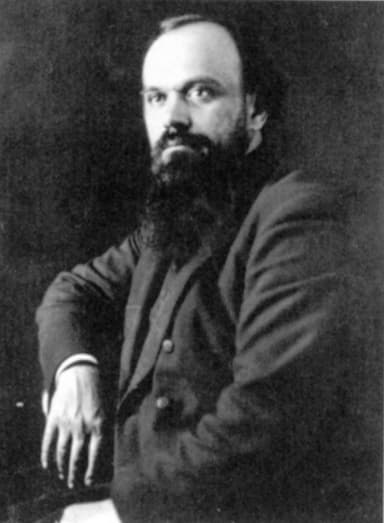
Envoy to the USA, 1915
Mission to England & America
In April 1915, the Serbian Church delegated Nikolai to England and America, where he conducted numerous lectures and advocated passionately for the unity of the Serbian and South Slavic peoples. His eloquence in English won him wide admiration in the West and earned him the title "Serbia's New Chrysostom" — a reference to the golden-tongued St. John Chrysostom. He remained abroad until 1919, when he returned to Serbia and was soon consecrated Bishop of Zica.
Episcopal Ministry
Zica
1919\u20131920
Consecrated bishop, succeeding Sava (Barac). His first episcopal appointment.
Ochrid
1920\u20131929
At the ancient see in Macedonia. Here he composed Prayers by the Lake and the Prologue from Ochrid.
Zica
1937\u20131956
Returned as bishop, succeeding Jefrem (Bojovic). Served until his repose in America.
In 1935, in a remarkable act of Christian charity, he oversaw the reconstruction of a cemetery for fallen German soldiers in Bitola — soldiers of the very nation that would soon imprison him.
Writings
St. Nikolai was extraordinarily prolific, modeling his hagiographical writing after the ancient literature of the Church. His complete works fill twenty-three volumes, published by Glas Crkve in Valjevo, Serbia.
The Prologue from Ochrid
1926
Lives of saints, hymns, reflections, and homilies for every day of the year. The text presented on this website.
Prayers by the Lake
1922
One hundred devotional prayers composed at Lake Ochrid, rich in poetic beauty and theological depth.
The Faith of Educated People
1928
An apologetic work addressed to the modern intellectual, defending the reasonableness of the Christian faith.
The Faith of the Saints
1949
An Orthodox catechism written in English during his years teaching at seminaries in America.
Imprisonment & Suffering · 1941\u20131945
In 1941, Nazi forces arrested St. Nikolai at the Monastery of Zica, which was subsequently looted and destroyed. He was transferred to the Monastery of Ljubostinja, where he witnessed the mass execution of innocent Serbs by firing squad.
“Is this the German culture, to shoot a hundred innocent Serbs for one dead German soldier! The Turks have always proved to be more just...”
— St. Nikolai, at Ljubostinja
He was later confined with Serbian Patriarch Gavrilo (Dozic) at the Monastery of Vojlovica near Pancevo. On December 14, 1944, both hierarch and patriarch were deported to the Dachau concentration camp, where St. Nikolai suffered imprisonment and torture that marked him for the rest of his earthly life.
Exile in America
Unable to return to Communist Yugoslavia, St. Nikolai emigrated to the United States in 1946 as a refugee. Despite the toll of imprisonment, he threw himself into teaching and writing at three Orthodox seminaries:
St. Sava's
Libertyville, IL
Instructor
St. Tikhon's
South Canaan, PA
Rector
St. Vladimir's
Crestwood, NY
Instructor
He continued writing in exile, producing The Faith of the Saints (1949) and Cassiana — the Science on Love (1952). St. Nikolai fell asleep in the Lord on March 18, 1956, at St. Tikhon's Monastery. His relics were later transferred to the Monastery of Lelic in Serbia, his birthplace.
Glorified · May 19, 2003
The Holy Assembly of Bishops unanimously entered Bishop Nikolai into the calendar of saints.
Commemorated on March 5/18 (Old Style / New Style), the anniversary of his repose. His relics rest at the Monastery of Lelic, which has become a place of pilgrimage.
Through his writings and his example of steadfast faith through persecution, St. Nikolai continues to nourish the faithful across the world.
Hymns
Troparion (Tone 8)
O golden-tongued preacher proclaiming the risen Christ, Everlasting guide of the cross-bearing Serbian people, Resounding harp of the Holy Spirit, and dear to monastics who rejoice in you, Pride and boast of the priesthood, teacher of repentance, master for all nations, Guide of those in the army of Christ as they pray to God, Holy Nicholas, teacher in America and pride of the Serbian people, With all the saints, implore the only Lover of mankind To grant us peace and joy in his heavenly kingdom!
Kontakion (Tone 3)
Born at Lelic in Serbia, You served as archpastor at the church of Saint Nahum in Ochrid. Taking your place on the throne of Saint Sabbas at Zica, You taught God's people and enlightened them with the Gospel. You brought people to repentance and the love of Christ, And for Christ you endured suffering at Dachau. Therefore we glorify you, a new Nicholas well-pleasing to God.
Sources
- Biographical information adapted from OrthodoxWiki, used under CC BY-SA 3.0. Photographs from Wikimedia Commons (public domain).
Holy Father Nikolai, pray to God for us!